

Helping critically ill patients get the nutrition they need
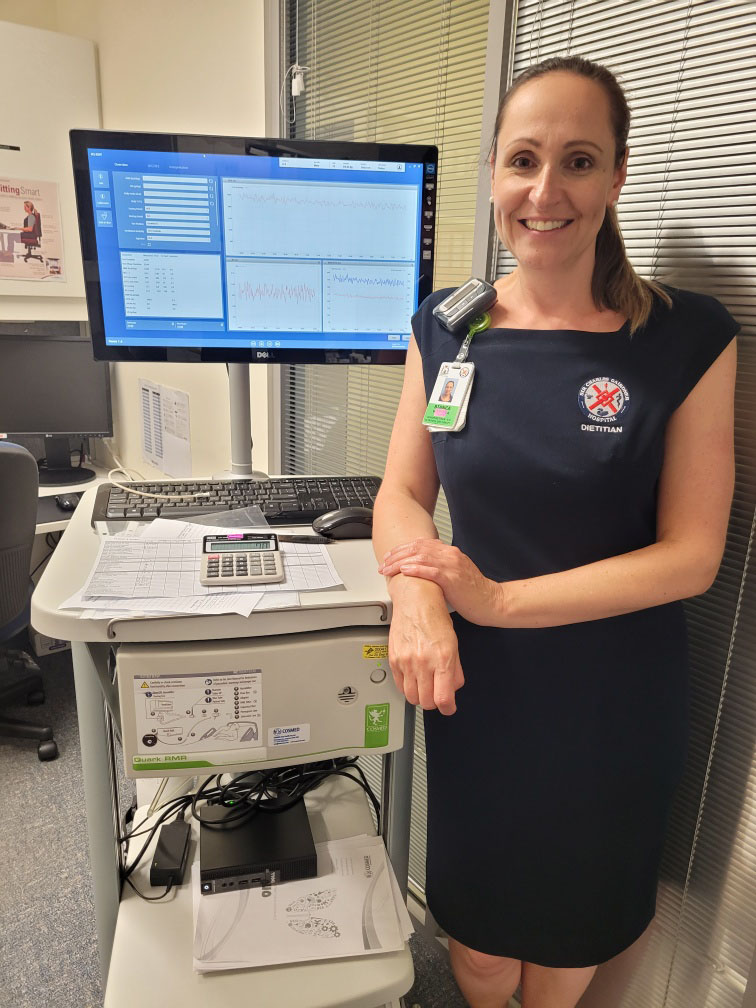 SCGOPHCG Dietitian Bianca Mammana
Sir Charles Gairdner Osborne Park Health Care Group Senior Critical Care Dietitian Bianca Mammana has recently undertaken a research project to help critically unwell patients in the Intensive Care Unit (ICU) get the nutrition they need.
The project has led the implementation of indirect calorimetry devices being used in the ICU to tailor nutrition to individual needs, minimise energy deficits or excesses, and provide safer, more precise, best-practice nutritional care.
Bianca has spent much of her career caring for some of the sickest patients in the hospital and looking for ways to optimise their nutrition.
She said that despite the highly precise and personalised care provided in intensive care, nutrition was often based on estimates rather than what a patient actually needed.
"Critically ill patients have rapidly changing and highly individualised energy requirements, and indirect calorimetry allows us to measure those needs and adjust nutrition accordingly," she said.
The research involved comparing patient’s measured energy requirements with commonly used predictive equations and explored how their energy needs related to infection and illness severity.
The results showed substantial differences between estimated and measured requirements, highlighting the limitations of relying on predictive equations alone and supporting the use of indirect calorimetry to better guide nutritional care.
Bianca's research led to the implementation of this technology in the ICU, and it is now routinely used in suitable critically ill patients as part of the standard of care.
"One of the most rewarding outcomes has been seeing our research translate directly into everyday patient care at SCGH ICU," said Bianca.
"The biggest benefit is that we can now personalise nutrition care based on what a critically ill patient’s body actually needs, rather than relying solely on an estimate.
"For me, that is the real value of translating research into practice – using evidence and technology to make nutrition care more precise, responsive and personalised for patients when they are at their most vulnerable."
Bianca's research was funded by both the Charlies Foundation for Research and the NMHS Building Allied Health Research Capacity Grant.
The funding has helped turn Bianca's findings into broader impact through presentations at state and national conferences and contributions to clinical guidelines.